
From Software Intelligence to Real-World Action: Why Physical AI Is the Next Step
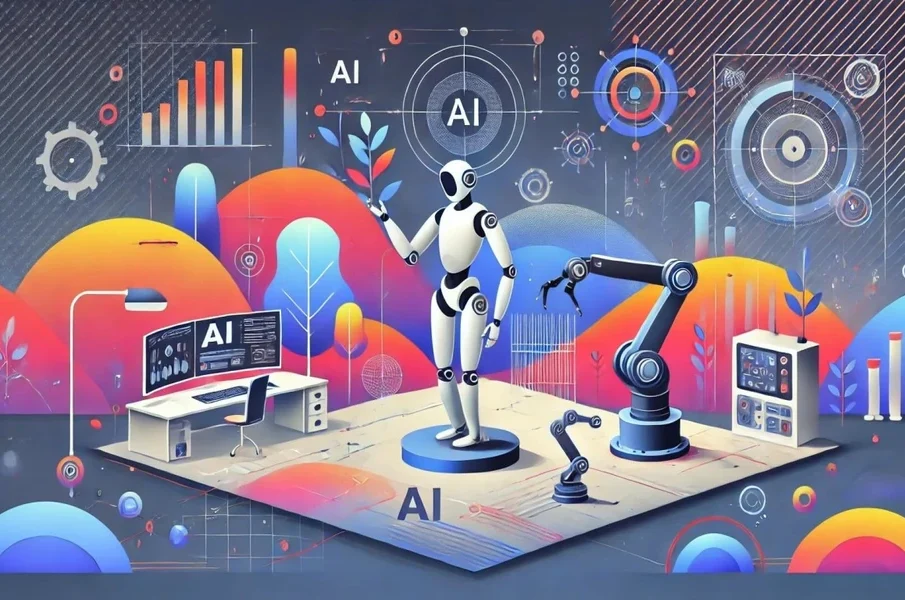
Artificial intelligence has become remarkably good at working with information. It can classify images, summarize documents, forecast demand, generate software and support decisions based on enormous volumes of data. Yet most AI systems still stop at the boundary between the digital and physical worlds: they can recommend what should happen, but they cannot necessarily make it happen on a factory floor, in a warehouse or around a piece of industrial equipment.
Physical AI is beginning to change that boundary. Instead of treating intelligence as something that lives primarily in software, it combines perception, reasoning and physical action in a continuous loop. For businesses, this shift could be more significant than simply adding another generation of robots, because it changes what kinds of real-world processes can realistically be automated.
The missing link between knowing and doing
Traditional enterprise AI is largely concerned with information flows. A predictive-maintenance system might identify unusual vibration in a machine, while a computer-vision model might detect a defective component and a planning algorithm might determine how production should be rescheduled. These are valuable capabilities, but another system – or a human operator-usually has to translate the resulting decision into physical action.
Physical AI brings those stages closer together. Sensors and cameras allow a machine to interpret its surroundings, AI models help determine an appropriate response, and robotic hardware executes that response while new sensor data verifies the result. NVIDIA describes this direction as systems capable of perceiving, reasoning and acting in complex physical environments, with simulation and robot learning playing an increasingly important role in their development.
The distinction matters because real workplaces are full of variability. Parts move slightly, packaging changes, objects arrive in unexpected orientations and operators occasionally modify the environment. Software intelligence can recognize those changes; physical intelligence must also decide what to do about them without turning every deviation into an engineering project.
Why conventional automation reaches a ceiling
Conventional industrial automation has delivered extraordinary productivity precisely because it reduces uncertainty. Engineers define the process, control the geometry and program equipment to repeat known movements as consistently as possible. In highly standardized, high-volume production, that remains an extremely effective model and is unlikely to disappear.
Problems become more visible when production is less predictable. A manufacturer running many product variants may need new fixtures, robot paths or integration work whenever the task changes. A system that performs brilliantly under one carefully controlled configuration can therefore become economically unattractive when changeovers are frequent or production volumes are too small to spread engineering costs across millions of identical cycles.
This is where greater machine autonomy becomes commercially relevant. In a production context, the value of Trener Physical AI depends on whether perception, decision-making, robot motion and verification can operate as one closed loop rather than as separate engineering layers. A robot that can identify the position and orientation of a component, choose an appropriate handling strategy and confirm that the action succeeded requires less environmental rigidity than one that simply repeats coordinates.
Simulation changes the economics of machine learning
Giving machines more autonomy introduces a difficult problem: training and testing physical systems in the real world is expensive. A software model can process millions of examples without damaging a production line, while a poorly trained robot can drop parts, collide with equipment or interrupt operations. Businesses therefore need development methods that allow much of the learning and validation to happen before a system reaches production.
Simulation and digital twins are becoming important parts of that infrastructure. Virtual environments can reproduce robot geometry, equipment, objects and physical interactions, allowing developers to test behaviours and generate synthetic training data without continuously occupying production equipment. NVIDIA is investing heavily in this cloud-to-robot workflow, combining simulation, robot-learning frameworks, AI models and edge computing as part of the development stack for intelligent robotics.
This does not mean simulated training eliminates commissioning. Friction, lighting, worn components, tolerances and unpredictable human behaviour remain difficult to model perfectly, so real-world validation is still essential. The commercial advantage is instead that more experimentation can take place earlier, while physical testing becomes a controlled stage of deployment rather than the primary method of discovering whether an idea works.
Physical AI is an operating-model question
The most important decisions around Physical AI may ultimately be organizational rather than technical. Traditional automation projects often separate responsibilities relatively clearly: automation engineers program the cell, operators run it, maintenance restores it when something fails and IT manages the surrounding digital infrastructure. Adaptive robotic systems create considerably more overlap between those disciplines.
A production problem, for example, may originate in mechanical wear, sensor quality, model behaviour, network performance or a change in how material enters the cell. Companies consequently need traceability that shows not only whether the robot stopped, but what it perceived and why it selected a particular response. Maintenance teams will increasingly need access to operational data, while automation specialists will need to understand AI performance rather than only deterministic control logic.
Governance also becomes more important as autonomy increases. Businesses must determine which decisions machines are allowed to make independently, where conservative fallback behaviour is required and when human intervention becomes mandatory. More capable automation should therefore be introduced with clearer operational boundaries, not with fewer of them.
The next competitive advantage may be flexibility
Physical AI should not be interpreted as a replacement for every PLC, fixed robot or conventional automation cell. Deterministic automation remains faster, simpler and easier to validate for many repetitive processes. The opportunity appears instead where companies currently tolerate manual work because conventional automation cannot economically cope with enough variation.
That makes flexibility an important metric alongside cycle time. A system that is marginally slower during an individual operation may still create more value if it handles additional product variants, reduces engineering effort during changeovers or keeps equipment productive when conditions vary. The relevant comparison is therefore increasingly not human versus robot, but rigid automation versus automation that can respond intelligently to what is actually happening around it.
As AI moves from analysing the world to interacting with it, the business discussion will also change. The question will no longer be only how much intelligence a company can put into its software, but how effectively that intelligence can be connected to machines, processes and physical outcomes. That transition- from prediction to action- is what makes Physical AI a potentially important next stage of enterprise automation.


